Imagine, for a second, a world where every piece of information lived in a single physical room. If you wanted to know the weather in London or the price of grain in Tokyo, you had to be standing in the right room at the right time. For most of human history, information was a localized, heavy thing. The story of the internet is the story of how we turned that “weight” into light.
The Birth of the “Network of the Networks”
The internet wasn’t a sudden “Eureka!” moment in a garage; it was born out of a cold-war necessity. In the late 1960s, the U.S. Department of Defense created ARPANET. They weren’t trying to build Instagram; they were trying to build a communication system that couldn’t be killed by a single strike.
The genius of the early internet was the move away from “circuit switching” (like old phone lines where you had a direct, fragile connection) to packet switching. Think of it like sending a book through the mail, but instead of sending the whole book, you rip out every page, put them in separate envelopes, and mail them individually. If one envelope gets lost, the post office just sends a copy of that single page. This is the foundation of the internet’s resilience.
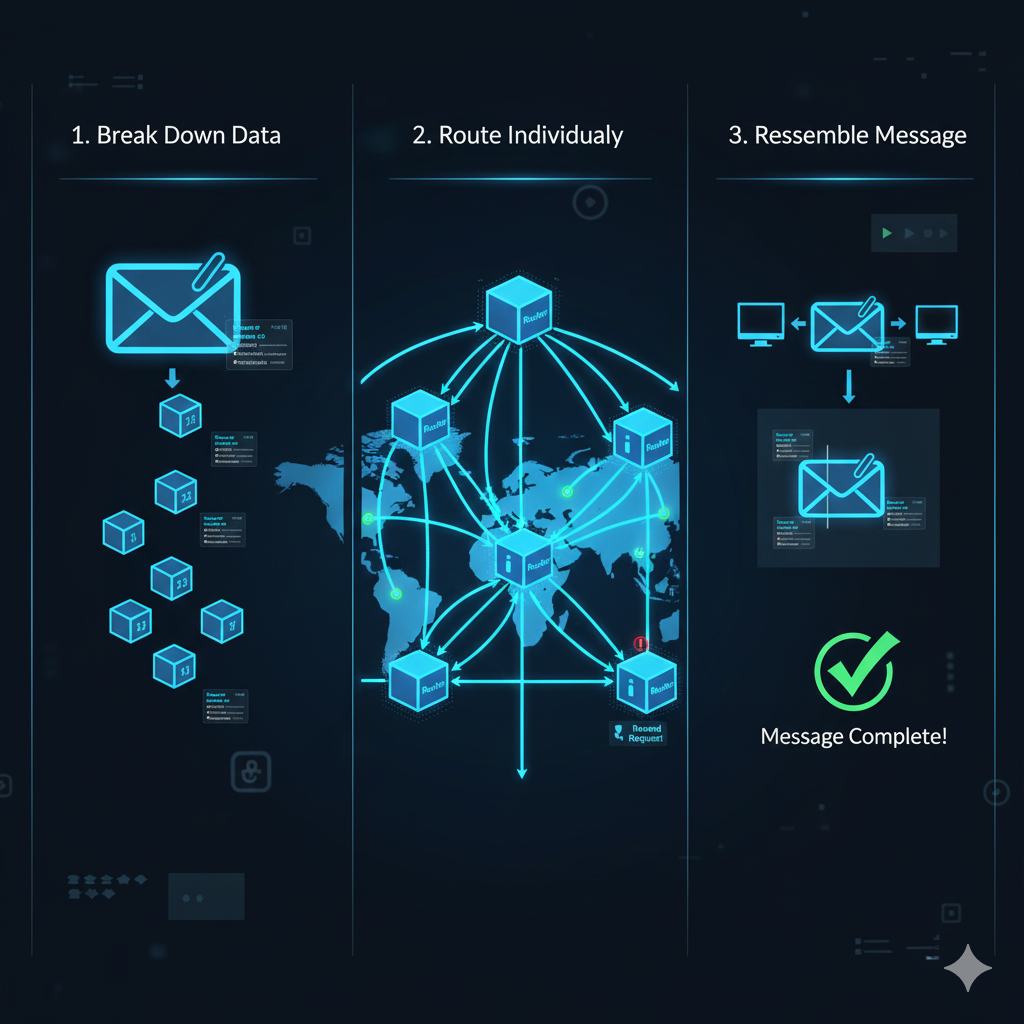
Language of the Web: Protocols
How do billions of different devices from a high powered server in Iceland to the smartphone in your pocket—understand each other? This is where programming enters the picture.
The internet is governed by Protocols, which are essentially just “global sets of rules” written in code. The most famous is TCP/IP. If the internet is the highway system, TCP/IP is the set of traffic laws. It dictates how data is packaged, addressed, and delivered.
When you type a URL, a massive, automated “phone book” called DNS (Domain Name System) translates that human-friendly name (https://www.google.com/search?q=google.com) into a machine-friendly IP address (142.250.190.46). This is a massive, distributed database managed by code, ensuring that your request finds its way through thousands of miles of undersea fibre-optic cables.
The Global Nervous System: Our Digital Life Support
In today’s world, the internet has transitioned from a high-tech novelty into the very air we breathe. It is the invisible backbone of modern existence, silently managing everything from the synchronization of traffic lights to the complex algorithms of global finance. We have reached a point where our society’s basic functions—banking, healthcare, and logistics are so deeply intertwined with the network that a major disconnection would bring civilisation to a functional standstill. For the programmer, this reality shifts the stakes: code is no longer just a set of instructions for a computer, but a responsibility to maintain the stability of this collective digital life support system.
Search my topics
Recent Posts
- Cosmic Chronicles:Blackholes and Wormhole February 7, 2026
- Cosmic Chronicles:Milky Way Madness February 6, 2026
- Cosmic Chronicles:Legend of Planets February 5, 2026
- New Year 2026 – A new Beginning for all January 1, 2026
- The Abyss: Earth’s great graveyard December 26, 2025
Categories
- All Categories
- All Categories
- Animals and Nature
- Book reviews
- Bubloo Scientist Updates
- Chemistry
- Coding and languages
- Computer Projects
- Food and Nutrition
- Geography
- Historical Science
- History
- Huzaifa's Blogs
- IT
- Mathematics
- Modernized world (New things)
- My business
- My travels
- Physics
- Science and Technology
- Space and Atmosphere
- Sports