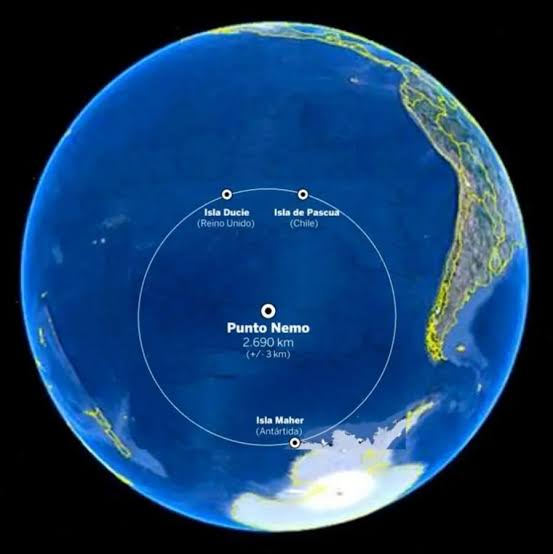
Imagine falling overboard in the middle of the South Pacific. You look in every direction—north, south, east, west—and see nothing but a flat, blue horizon. You are at Point Nemo, the “Oceanic Pole of Inaccessibility.”
Named after Captain Nemo from Jules Verne’s Twenty Thousand Leagues Under the Sea, “Nemo” literally translates from Latin as “no one.” It is a place defined not by what is there, but by what isn’t.
Closer to starts than shore
Point Nemo is so remote that the nearest dry land—a tiny, uninhabited island called Ducie Island—is over 2,688 kilometers away. To put that in perspective, if you were floating there right now, the closest human beings to you wouldn’t be on a ship or a distant coast.
They would be the astronauts aboard the International Space Station, orbiting roughly 400 kilometers above your head. In this watery desert, you are more connected to the heavens than to the Earth.
The Spacecraft Cemetery
Because Point Nemo is the furthest point from human life, it has become the final resting place for our greatest technological achievements. Since the 1970s, global space agencies have used this coordinate as a “jettison zone” for decommissioned satellites and space stations.
Beneath the waves lies a silent graveyard of titanium and solar panels:
• The Mir Space Station: Russia’s legendary orbital home was de-orbited here in 2001.
• Cargo Ships: Dozens of automated transfer vehicles have been steered into these waters.
• The Future: In 2031, the International Space Station itself is scheduled to make its final, fiery descent into the depths of Point Nemo.
There is a haunting irony in it: the most isolated spot on our planet is the only place where the debris of our journey into the stars comes back to rest.
A Desert in the deep
You might expect such a vast area of the ocean to be teeming with life, but Point Nemo is a biological wasteland. It sits inside the South Pacific Gyre, a massive rotating current that prevents nutrient-rich water from entering the area.
With no “food” coming in from the coasts and no deep-sea currents stirring up nutrients from below, the water is a brilliant, eerie blue—so clear it’s almost transparent. It is a desert of water, where the silence is absolute and the biodiversity is nearly zero.
The Bloop
In 1997, oceanographers recorded one of the loudest underwater sounds ever captured near Point Nemo. It was an ultra-low-frequency sound, nicknamed “The Bloop,” that was heard by sensors over 5,000 kilometers apart. For years, people whispered about sea monsters or undiscovered giants living in the isolation of the abyss.
Science eventually gave us a colder answer: it was likely the sound of a massive icequake—a giant iceberg cracking off Antarctica. But the legend persists because Point Nemo is exactly the kind of place where we want monsters to exist. It is the last great blank space on the map.
Search my topics
Recent Posts
- Cosmic Chronicles:Blackholes and Wormhole February 7, 2026
- Cosmic Chronicles:Milky Way Madness February 6, 2026
- Cosmic Chronicles:Legend of Planets February 5, 2026
- New Year 2026 – A new Beginning for all January 1, 2026
- The Abyss: Earth’s great graveyard December 26, 2025
Categories
- All Categories
- All Categories
- Animals and Nature
- Book reviews
- Bubloo Scientist Updates
- Chemistry
- Coding and languages
- Computer Projects
- Food and Nutrition
- Geography
- Historical Science
- History
- Huzaifa's Blogs
- IT
- Mathematics
- Modernized world (New things)
- My business
- My travels
- Physics
- Science and Technology
- Space and Atmosphere
- Sports