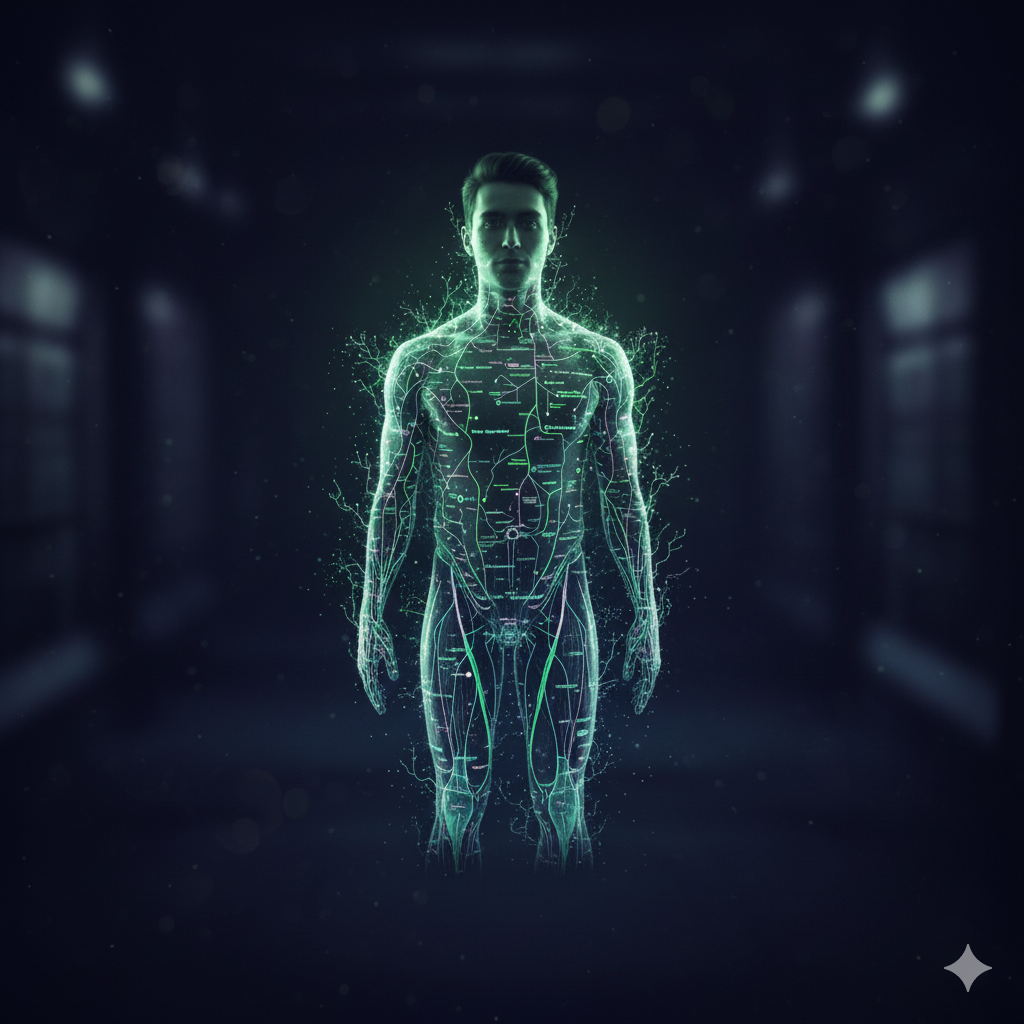
Have you ever imagined yourself as something out of a science fiction movie, perhaps glowing faintly in the dark? While you won’t be lighting up a room like a firefly, the truth is, you are actually bioluminescent! That’s right, every human being emits a tiny, almost imperceptible amount of visible light.
For centuries, ancient texts and spiritual traditions have hinted at an “aura” or a subtle energy field surrounding living beings. While often dismissed as folklore, modern science has actually found a quantifiable basis for this idea, albeit on a much more subtle level than glowing halos. In a groundbreaking study, scientists from Tohoku Institute of Technology in Japan used highly sensitive cameras to capture this faint light emitted from the human body. The results were astonishing: humans do indeed glow, and this glow follows a fascinating daily rhythm.
Science behind your glow
So, what causes this internal light show? It’s not magic, but rather the magic of biochemistry! The light we emit is a byproduct of normal metabolic processes within our cells. Specifically, it’s linked to reactions where highly reactive molecules called free radicals interact with lipids and proteins. When these molecules collide, they release energy in the form of photons – tiny particles of light. Most of this light is in the infrared spectrum, which our eyes can’t see, but a small fraction falls within the visible light range.
The Japanese study revealed that this bioluminescence isn’t constant. It fluctuates throughout the day, being weakest in the morning and reaching its peak intensity in the late afternoon or early evening. Researchers speculate that this rhythmic glow might be connected to our circadian rhythm, the internal biological clock that regulates our sleep-wake cycles and other bodily functions. It could also be influenced by metabolic rates, body temperature, and even stress levels, though more research is needed to fully understand all the contributing factors.
Why does it matter?
While you won’t be abandoning your flashlights anytime soon, the discovery of human bioluminescence opens up exciting new avenues for biological and medical research. Imagine a future where doctors could detect subtle changes in this bodily glow to identify early signs of disease, track metabolic health, or even assess overall well-being. It could provide a non-invasive way to monitor cellular health and function, potentially revealing insights long before symptoms become apparent.
The fact that our bodies are constantly performing these complex, light-emitting reactions is a powerful reminder of the incredible, often unseen, biological wonders happening within us every second. It’s a testament to the show the dance of chemistry that keeps us alive and, apparently, faintly glowing. So, the next time you look in the mirror, remember: you’re not just seeing skin and bone, you’re looking at a living, breathing, subtly luminous being. It’s a pretty cool secret to carry, don’t you think?
Search my topics
Recent Posts
- Cosmic Chronicles:Blackholes and Wormhole February 7, 2026
- Cosmic Chronicles:Milky Way Madness February 6, 2026
- Cosmic Chronicles:Legend of Planets February 5, 2026
- New Year 2026 – A new Beginning for all January 1, 2026
- The Abyss: Earth’s great graveyard December 26, 2025
Categories
- All Categories
- All Categories
- Animals and Nature
- Book reviews
- Bubloo Scientist Updates
- Chemistry
- Coding and languages
- Computer Projects
- Food and Nutrition
- Geography
- Historical Science
- History
- Huzaifa's Blogs
- IT
- Mathematics
- Modernized world (New things)
- My business
- My travels
- Physics
- Science and Technology
- Space and Atmosphere
- Sports