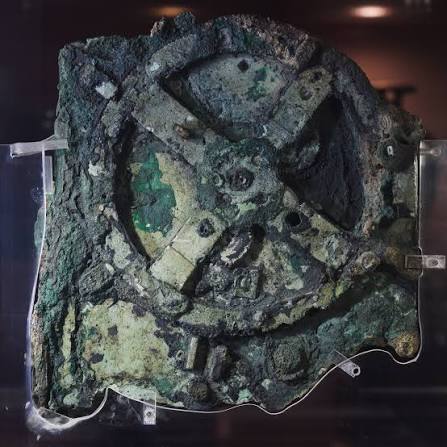
In 1901, a group of sponge divers escaping a storm off the coast of the Greek island of Antikythera stumbled upon a shipwreck that would rewrite human history. Among the marble statues and bronze treasures was a green, calcified lump of metal that looked like nothing more than a discarded rock.
For decades, it sat in a museum, ignored. But when scientists finally peered inside using X-ray tomography, they didn’t find a relic—they found a computer.
A discovery which shouldn’t have existed
The Antikythera Mechanism is a complex system of over 30 interlocking bronze gears, dating back to roughly 150-100 BCE. To put that in perspective, technology of this complexity didn’t reappear in the human record for another 1500 years, when the first mechanical clocks were developed in Europe.
Imagine finding a functional internal combustion engine inside a Pharaoh’s tomb. That is the level of shock this device caused in the scientific community. It challenges our entire “linear” view of history—proving that the ancients were far more advanced than we ever dared to imagine.
What was it used for?
This wasn’t just a toy; it was a handheld universe. By turning a small hand crank, the user could:
• Predict Eclipses: It calculated the exact day and hour of solar and lunar eclipses years into the future.
• Track the Heavens: It displayed the positions of the five known planets (Mercury, Venus, Mars, Jupiter, and Saturn) with startling accuracy.
• Calendar Management: It kept track of the four-year cycle of the Olympic Games.
The back of the device even featured a spiral dial that accounted for the Saris Cycle, a 18-year period used to track the recurrence of eclipses. The math required to build this—incorporating prime numbers like 127 and 235 into gear teeth—is staggering.
The ‘Ghost’ of lost knowledge
The most haunting thing about the Antikythera Mechanism isn’t that it exists; it’s that it’s the only one we’ve ever found. History books often portray the ancient world as a time of simple tools and myths. This device proves there was a massive “Silicon Valley” of the ancient Mediterranean—likely centered around Rhodes or Syracuse—where geniuses like Archimedes or Hipparchus were merging advanced mathematics with high-precision engineering.
When the Roman Empire rose and the Library of Alexandria fell, this knowledge didn’t just fade; it vanished. The Antikythera Mechanism is a “ghost” of a scientific revolution that was cut short.
Search my topics
Recent Posts
- Cosmic Chronicles:Blackholes and Wormhole February 7, 2026
- Cosmic Chronicles:Milky Way Madness February 6, 2026
- Cosmic Chronicles:Legend of Planets February 5, 2026
- New Year 2026 – A new Beginning for all January 1, 2026
- The Abyss: Earth’s great graveyard December 26, 2025
Categories
- All Categories
- All Categories
- Animals and Nature
- Book reviews
- Bubloo Scientist Updates
- Chemistry
- Coding and languages
- Computer Projects
- Food and Nutrition
- Geography
- Historical Science
- History
- Huzaifa's Blogs
- IT
- Mathematics
- Modernized world (New things)
- My business
- My travels
- Physics
- Science and Technology
- Space and Atmosphere
- Sports